
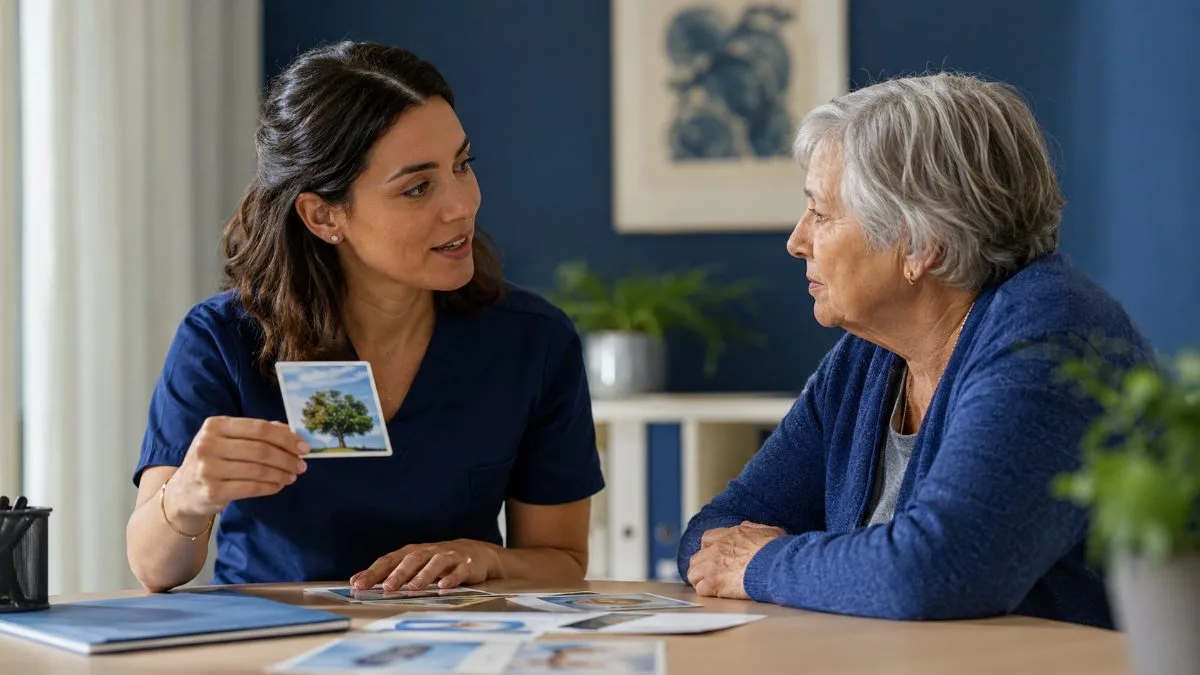
A stroke can in an instant take away something that a whole lifetime made seem obvious, the ability to speak and understand. For the patient and their loved ones it is an enormous shock. It is important to know, however, that aphasia does not mean a loss of intelligence, and that in many cases speech can be recovered step by step.
What is aphasia?
Aphasia is a disorder of speech and language that arises from damage to the areas of the brain responsible for communication, most often as a result of a stroke. It can affect speaking, understanding, reading and writing. Very importantly, aphasia is not a mental illness or a loss of intelligence. A person with aphasia usually knows what they want to say, but has difficulty finding the words or understanding them.
Types of aphasia
Depending on the site and extent of the damage, aphasia takes different forms. The most commonly described include:
- Motor aphasia, when the person understands speech but has difficulty producing it, speaks with effort, in short phrases, breaking up words.
- Sensory aphasia, when speech is fluent but understanding is impaired, and utterances can be incoherent.
- Mixed and global aphasia, when difficulties affect both speaking and understanding.
Alongside aphasia after a stroke, dysarthria often appears, that is, difficulty with articulation resulting from weakened muscles of the speech apparatus. It requires somewhat different therapeutic work.
Two people after a stroke can have a completely different picture of aphasia. This is why we always precede therapy with a thorough assessment and tailor the plan to the individual patient and their capabilities.
Why does time matter?
The brain has the capacity to reorganise, that is, neuroplasticity, thanks to which healthy areas can partly take over lost functions. This capacity is greatest in the first period after a stroke, which is why an early start to speech rehabilitation is so important. This does not mean, however, that therapy later loses its sense. Speech therapy work can be effective in the later period too, and regularity is just as important here as the time of starting.
Stroke is one of the most common causes of disability in adults. It is estimated that aphasia affects a significant proportion of people after a stroke, especially with damage to the left hemisphere, where in most people the centres of speech are located. This shows how important quick access to speech therapy is.
What can be expected from therapy?
The most common question from loved ones is whether speech will return. The honest answer is that it depends, because the pace and extent of improvement are very individual and depend on the extent of the damage, the type of aphasia, age, general health and the regularity of therapy. In many people communication gradually improves, though it does not always return to its state before the stroke. This is why in therapy we focus not only on recovering speech, but also on communicating effectively through available channels, here and now.
What does speech therapy look like?
Aphasia therapy is an individually planned process, carried out patiently and at a safe pace. Depending on the type of difficulty, we work on:
- recovering words and building utterances,
- understanding speech and instructions,
- reading and writing,
- articulation and the efficiency of the speech apparatus, with co-occurring dysarthria,
- alternative ways of communicating, when speech returns more slowly.
We describe the full scope on the post-stroke therapy page. We often also cooperate with a neurologist and a psychologist, because a stroke affects not only speech but also emotions.
How can the family support a person with aphasia?
Loved ones are an irreplaceable part of therapy. Here is what genuinely helps:
- Speak calmly, in simple sentences, give time to respond and do not finish sentences for the person.
- Support words with gesture, image, writing, make communication easier through various channels.
- Do not pretend to understand when you do not, ask again calmly and patiently.
- Include your loved one in conversations and decisions, do not talk about them in the third person in their presence.
- Value every bit of progress and keep the atmosphere free of pressure.
The loss of speech can be a source of frustration, anxiety and low mood. Patience, acceptance and the sense that loved ones are there matter enormously for motivation and the results of rehabilitation.
The most common questions from loved ones
Does a person with aphasia understand what is said to them?
It depends on the type of aphasia. In motor aphasia understanding is often preserved, despite difficulty with speaking. In sensory aphasia it is precisely understanding that is impaired. It is always worth speaking with respect and not assuming in advance that the person does not understand.
How long does aphasia therapy last?
Speech rehabilitation is usually a long-term process, measured in months, sometimes years. We set the plan and frequency of sessions individually, depending on the patient's needs and capabilities.
Do exercises at home make sense?
Yes, regular, short exercises between sessions strongly support the effects of therapy. The speech therapist advises how to work at home without overloading the person after a stroke.
You are not alone
Aphasia is a journey the whole family goes through, not only the patient. Well-planned therapy, real support from loved ones and patience can restore not only words, but also a sense of agency and contact with those closest. At BELMED® in Tczew we provide speech-therapy rehabilitation of speech for adults after strokes and brain surgery.
Has a loved one lost their speech after a stroke?
Book a consultation. We will assess the difficulties and propose a speech-therapy plan tailored to the patient's capabilities.
This article is for information only and does not replace a consultation or assessment. For an individual evaluation, see the post-stroke therapy page.