
ADHD is one of the most common neurodevelopmental disorders. For many people, medication remains the basis of treatment, yet some parents and adult patients look for methods that support the brain in learning self-regulation without medication or alongside it. One such method is EEG Biofeedback, also called neurofeedback.
What is EEG Biofeedback?
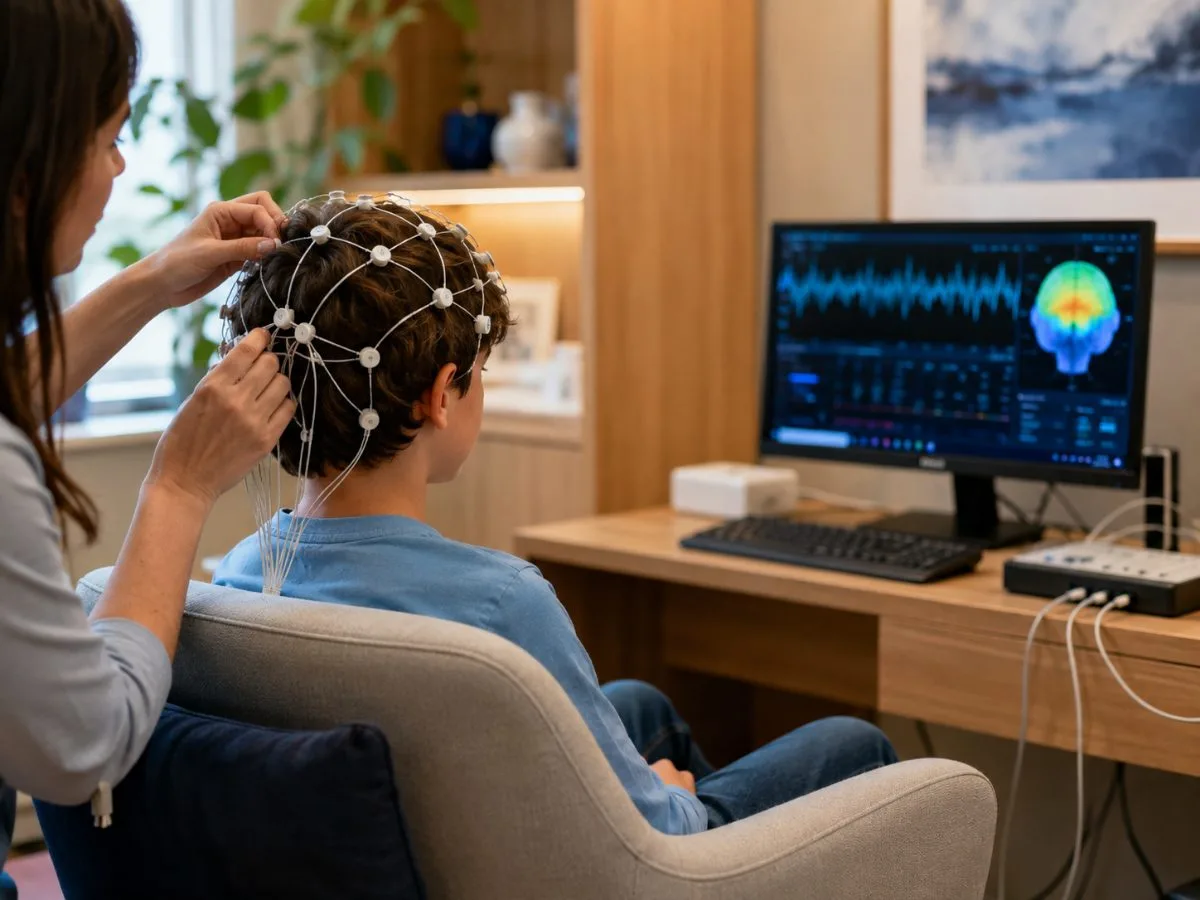
EEG Biofeedback is a non-invasive brain training based on biological feedback. We place sensors on the scalp that only read the activity of brain waves. They do not deliver any current and do not stimulate the brain. The signal goes to a computer and is presented as a simple game or animation, which the person training controls solely with the work of their own mind.
When the brain works in the desired way, that is, generates waves that favour focus and calm, the game rewards that state. Over time the brain learns to hold useful patterns of activity more and more easily. It is a learning process, similar to training, in which a repeated exercise consolidates a new skill.
Why is EEG Biofeedback helpful in ADHD?
In many people with ADHD a characteristic pattern of brain activity is observed, among others an excess of slow waves in the areas responsible for attention and impulse control. The aim of the training is to teach the brain to strengthen the waves linked with alert focus and quieten those associated with distraction and drowsy attention.
Importantly, EEG Biofeedback does not calm the child or adult from the outside. It builds an internal skill that the patient uses even after therapy ends. This distinguishes it from the action of medication, which works here and now, as long as its concentration in the body is maintained.
Areas that most often improve
- Concentration and sustained attention during study, work and tasks that require effort.
- Impulse control, that is, less acting on the spur of the moment and calmer reactions.
- Emotional self-regulation, easier coping with frustration and tension.
- Sleep and calming down, more efficient winding down of arousal in the evening.
EEG Biofeedback as an alternative to medication
This question comes up most often in the consulting room, so we answer it directly and honestly. EEG Biofeedback is sometimes considered an alternative to medication in some people with ADHD, especially when symptoms are milder, when there are contraindications to medication, or when a family consciously wants to try a medication-free method first. In other patients it works as a complement to treatment, allowing the effects of therapy to be used better and lasting attention habits to be worked on.
EEG Biofeedback does not replace a diagnosis or a psychiatric consultation. A treating doctor always decides on starting, changing or stopping medication. Our role is to run the training and cooperate with the patient and, when needed, with specialists.
This approach, combining a reliable assessment with brain training, gives the fullest picture and the best effects. If you are wondering about ADHD in yourself or your child, it is worth starting with an ADHD assessment, which at BELMED® we combine, among others, with an assessment of how the brain works.
What does the therapy look like, step by step?
- Initial assessment. An interview and an assessment of how the brain works, and if needed a miniQEEG assessment, which helps to select the training protocol precisely.
- Training plan. We set the goals and the wave parameters we want to strengthen or quieten.
- Training sessions. The patient controls the game with the work of the mind alone. Sessions are regular and usually last from a dozen to several dozen meetings.
- Consolidation and monitoring. We track progress and modify the plan until the changes achieved are consolidated.
What do brain waves say in ADHD?
To understand why the training works, it is worth getting to know the language of brain waves. The brain constantly generates electrical rhythms of different frequencies, and each is linked with a different state of mind:
- Theta waves (4 to 8 Hz) dominate in a state of daydreaming, drowsiness and "drifting away" in thought. In many people with ADHD there is an excess of them in situations that require focus.
- SMR and low beta waves (12 to 18 Hz) accompany calm, alert concentration and the control of movement and impulses.
- Beta waves (18 to 30 Hz) are linked with active thinking and processing information.
Research on ADHD often describes a raised so-called theta to beta ratio, that is, a predominance of waves that favour distraction over waves of focus. EEG Biofeedback training teaches the brain to reverse that proportion, to strengthen the rhythms of attention and quieten those that knock it off task. This is not magic, but a repeated exercise that gradually changes the brain's working habit.
What does science say about effectiveness?
EEG Biofeedback has been studied for several decades, and in the context of ADHD it is among the best-described non-pharmacological methods. Some attention and self-regulation training protocols are classified in the literature as an approach with well-documented foundations. At the same time, honesty requires clarity, the results vary between people, and the quality of studies is not uniform.
That is why in the consulting room we avoid promises without cover. We speak of a supporting method whose effectiveness depends on an accurate diagnosis, a well-chosen protocol, regular sessions and the family's involvement. We treat it as an element of a broader plan, not a miracle solution.
What can realistically be expected?
Parents' most common question is when will I see a change. The honest answer is it depends, but we can sketch a typical picture:
- First signals, usually after a few to a dozen sessions, for example calmer evenings, shorter outbursts of frustration or slightly longer focus on a task.
- Clearer effects, when the training continues regularly and is consolidated, most often in the second half of the planned series of sessions.
- Durability, because the brain learns a skill, the benefits usually persist after the programme ends, though some people use refresher sessions.
At the start we set concrete, observable goals, for example doing homework without getting up several times, fewer impulsive reactions in a group or falling asleep more easily. This makes progress possible to assess, not just to feel.
What strengthens the effects of training?
EEG Biofeedback works best when it is not the only element of support. In practice, results are improved by:
- an ordered daily rhythm, sleep and limiting an excess of screen stimulation,
- clear rules and a predictable environment at home and at school,
- cooperation with teachers and, if needed, a psychologist,
- physical activity, which naturally supports the regulation of attention,
- parental support in building habits, step by step, without pressure.
When to be cautious, and when not to start
The training is safe, but it is not a solution for everything. We are cautious or refer to a doctor first when there are unrecognised epileptic seizures, serious neurological or psychiatric disorders requiring urgent care, or when symptoms are severe and it is safer to start with a specialist consultation. EEG Biofeedback does not replace an ADHD diagnosis or psychiatric care, but complements them well.
Who is EEG Biofeedback for?
The method is safe and non-invasive, and works for children, teenagers and adults. We most often propose it for:
- ADHD and difficulties with concentration, attention and excessive impulsivity,
- psychomotor hyperactivity and difficulty calming down,
- tension, stress and difficulty regulating emotions,
- sleep problems,
- supporting learning, memory and mental efficiency, also in adults.
Frequently asked questions
Do the effects last?
Because EEG Biofeedback builds a skill rather than a momentary effect, the changes achieved usually persist after the training ends. This is one of the most frequently emphasised advantages of the method.
Does the training hurt?
No. The sensors only read the signal from the surface of the head. The patient watches a game or animation, and the whole thing is calm and painless.
Where do we start?
With a consultation and an initial assessment. On that basis we will say whether EEG Biofeedback is indicated and what a training plan might look like in a given case.
Does EEG Biofeedback combine with ADHD therapy in adults?
Yes. In adults, training attention and self-regulation can be valuable support in organising work, controlling impulses and coping with stress, also alongside treatment led by a doctor.
Considering EEG Biofeedback for ADHD?
Book a consultation. Together we will assess whether brain training is a good direction for you or your child.
This article is for information and education. It does not replace a medical consultation or an individual diagnosis. Decisions on pharmacological treatment of ADHD are made by a doctor. You can read more about the method itself on the EEG Biofeedback therapy page.