
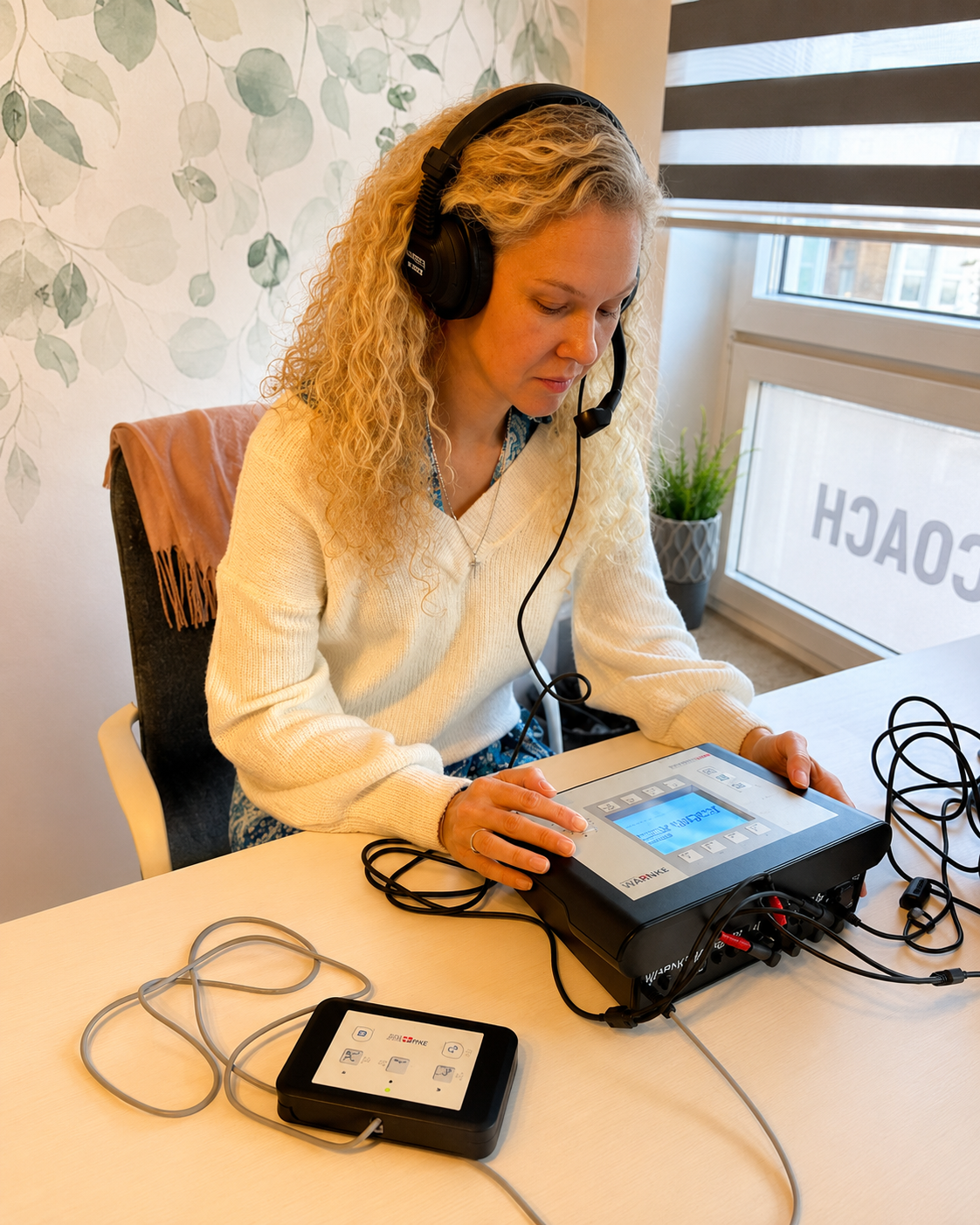
Reading seems like a single skill, but it is in fact a complex process built on many underlying functions, auditory, visual and motor. When one of them works less well, the child reads with enormous effort. The Warnke Method helps to train and automatise these foundations.
What is the Warnke Method?
The Warnke Method is a modern system of assessment and therapy developed by the German expert Fred Warnke. It focuses on the functions that underlie fluent reading, writing and speaking, that is, auditory, visual and motor processing and their automatisation. Unlike passive listening, the method actively engages the child, which genuinely increases the effectiveness of the training.
What does dyslexia have to do with processing stimuli?
In many children with dyslexia we observe difficulties with fast, precise processing of auditory and visual stimuli, and with automatisation. The brain needs more time to distinguish similar speech sounds, link a sound with a letter or smoothly track the eyes across a line. The result is slow, tiring reading, mixing up letters and errors. The Warnke Method trains exactly these underlying functions so they become faster and more automatic.
How does the training work?
We run the training on specialist equipment, and some exercises can be continued at home with the Brain-Boy device. The exercises include, among others:
- distinguishing the order and duration of sounds,
- locating sound and coordinating the work of both ears,
- visual-motor coordination and eye tracking,
- combining auditory, visual and motor stimuli,
- automatisation, that is, performing tasks faster and more confidently.
We always precede training with an assessment that shows which functions need work. This way the programme is tailored to the child, not universal. We describe the details on the Warnke Method assessment page.
Who is the Warnke Method for?
The training works well in children from the age of six and in adults. We recommend it, among others, for:
- the risk of dyslexia and diagnosed dyslexia,
- difficulties learning to read and write,
- auditory processing disorder (APD),
- difficulties with auditory attention and concentration,
- speech and lateralisation difficulties.
What can you expect?
Effects are individual and depend on regularity and the starting point. Parents most often describe a gradual improvement in reading fluency, less fatigue and greater confidence with texts. It is important to treat the training as part of broader support. It works best combined with educational therapy and calm, everyday reading practice.
What does research say about the basis of dyslexia?
Dyslexia is one of the best-researched learning difficulties. Contemporary studies, including work in neuroimaging, indicate that its basis lies above all in difficulties with phonological processing, that is, in being aware of and operating with speech sounds. A child who distinguishes and analyses sounds less well later has trouble linking sound to letter, and that is the foundation of decoding words.
Some researchers, including the strand begun by Paula Tallal, also point to the role of rapid auditory processing, that is, the brain's ability to capture short, rapidly successive sounds. It is precisely these timing functions that the Warnke Method trains. It is worth stating honestly, however, that the scientific evidence on auditory processing training itself is ambiguous, and we treat the method as support for underlying functions, not as a standalone treatment for dyslexia.
Dyslexia occurs regardless of intellectual level. A child with dyslexia can be very bright and creative, and yet read laboriously. This gap between ability and school results is one of the important signals to look more closely at the difficulties.
Automatisation, or why repetition makes sense
Fluent reading requires automatisation, that is, performing basic operations without conscious effort. When recognising letters and joining them into words consumes all of a child's attention, none is left for understanding the content. Through repeated, gradually harder exercises, the Warnke Method helps make these processes more automatic. This lets the child's attention shift from laborious sounding-out to the meaning of the text.
How does the process work step by step?
- Assessment of underlying functions. We check auditory and visual processing and coordination to learn the child's profile of difficulties.
- Setting the plan. We choose the scope and intensity of the training and set realistic goals.
- Training in the consulting room. Regular, short sessions on Warnke equipment, run by a specialist.
- Continuation at home. The child does some of the exercises with the Brain-Boy device, which speeds up progress.
- Monitoring effects. We track changes and modify the programme as improvement comes.
Signs of dyslexia worth not ignoring
Recognising the risk of dyslexia early gives a child an enormous advantage. It is worth looking more closely at the difficulties if the child:
- reads slowly, sounds out words long after peers and is reluctant to pick up a book,
- mixes up letters that look similar, for example b and d, or sound similar, for example p and b,
- loses lines, omits and transposes letters and syllables,
- writes with many errors despite knowing the spelling rules,
- has trouble remembering sequences, days of the week, times tables,
- distinguishes speech sounds poorly and struggles with auditory analysis and synthesis of words.
Such symptoms do not settle a diagnosis of dyslexia, but they are a good reason for a consultation. An early assessment lets support be put in place before the difficulties affect the child's self-esteem.
The Warnke Method and other methods
We often combine Warnke with other approaches. For auditory difficulties the Tomatis® Method can help, and for broader developmental challenges, educational and speech therapy. We always base the choice of methods on an assessment, because it is the assessment that shows where the source of the difficulty lies. You will find the full training offer on the Warnke Method therapy page.
How to support reading at home?
- Read together every day, briefly and without pressure, taking turns.
- Choose texts at the child's level, so they finish with a sense of success.
- Value effort, not only speed and accuracy.
- Combine reading with play, word games and listening to audiobooks.
- Keep things calm and avoid rushing during learning.
If reading difficulties persist despite your work, it is worth consulting a specialist. At BELMED® in Tczew we provide assessment and therapy using the Warnke Method.
Does your child struggle with reading?
Book a consultation. We will check whether the source of the difficulty is auditory and visual processing, and choose the right training.
This article is for information only and does not replace a consultation or assessment. For an individual evaluation, see the Warnke Method assessment and Warnke Method therapy pages.