
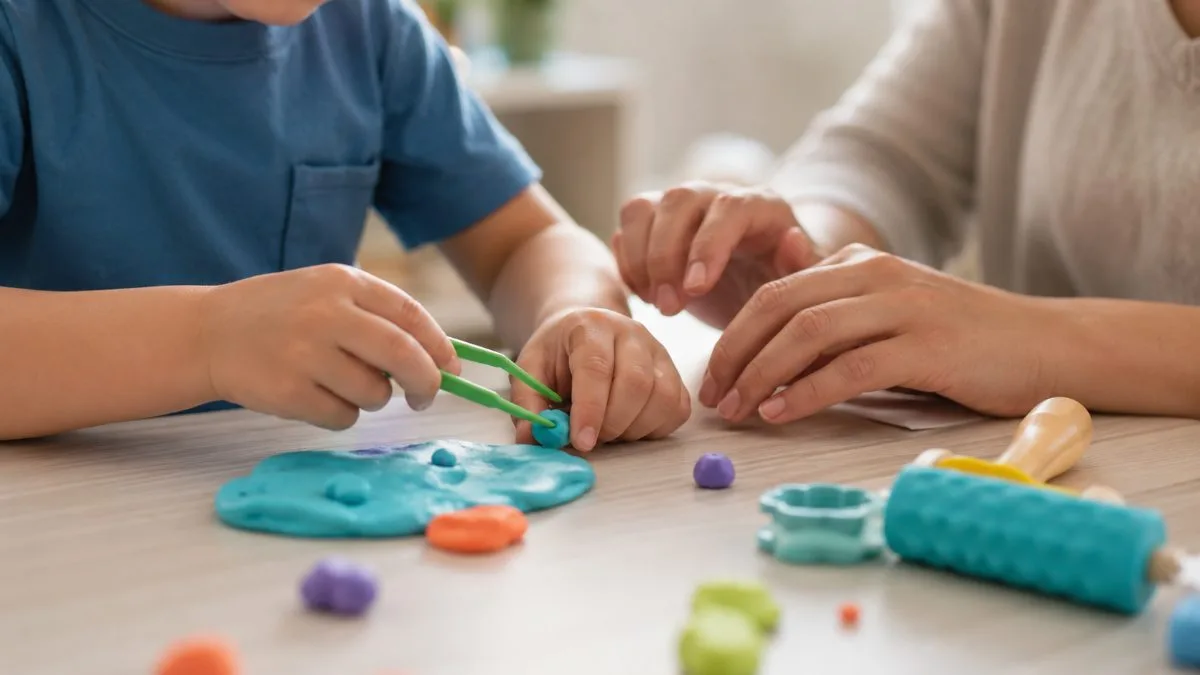
The hand is the tool with which a child explores the world, plays, draws and finally writes. When its skill develops more slowly, everyday tasks demand enormous effort from the child. The result is often reluctance, frustration and avoidance. Hand therapy helps develop these skills in a friendly, play-based way.
What is hand therapy?
Hand therapy is a set of targeted exercises that develop fine motor skills, that is, the precise movements of the hand and fingers, grip strength and hand-eye coordination. It is not only about neat handwriting. A skilled hand is the foundation of independence, from eating with cutlery, through getting dressed, to play and learning.
Why does a child need a skilled hand?
Fine motor development translates into a great many areas of everyday life:
- learning to write, draw and paint,
- self-care, doing up buttons, tying shoelaces, using cutlery,
- manual play, arranging, cutting, modelling, building,
- concentration and perseverance, because precise tasks teach patience.
Signs it is worth having a child's hand assessed
Contact a specialist if you notice that your child:
- is reluctant to draw or colour and avoids manual play,
- holds the crayon or pencil incorrectly or in a cramped way,
- presses too hard or too softly when writing and drawing,
- tires quickly at the table and complains of a sore hand,
- has difficulty doing up buttons, tying shoelaces, using scissors,
- writes carelessly, does not stay within the lines, has trouble copying shapes,
- has reduced or increased muscle tone in the hand.
A child who avoids drawing is usually not lazy, but discouraged. They are doing something that is genuinely difficult and brings no satisfaction. Therapy reverses this spiral, because it starts with successes suited to the child.
What affects fine motor development?
The skill of the hand does not develop in isolation from the rest of the body. It depends on the muscle tone of the whole trunk and shoulder girdle, on stability, and also on the integration of the senses, including deep sensation and touch. That is why good hand therapy takes a broader view and often combines precise exercises with work on posture, balance and coordination of the whole body. In some children, manual difficulties co-occur with challenges in sensory integration.
What does hand therapy at BELMED® look like?
We start with an assessment of the level of a child's fine motor skills and what lies behind the difficulties. We then draw up an individual plan and run sessions in the form of play, because that motivates a child to make an effort best. In the exercises we use, among other things, modelling materials, stamps, threading, tearing, hand obstacle courses and grip games. You will find details on the hand therapy page.
How to support the skill of the hand at home?
Everyday, ordinary play makes an enormous difference. It is worth:
- modelling with plasticine, salt dough and play dough, tearing and crumpling paper,
- threading beads, lacing, arranging small elements,
- drawing on large surfaces, on a board, with chalk on the pavement, on a vertical sheet,
- cutting with scissors, painting with fingers and a brush,
- involving the child in everyday tasks, pouring, transferring, kneading dough,
- taking care of a correct posture at the table and a proper grip.
A dozen or so minutes of manual play a day gives better results than long, tiring sessions once in a while. Short, frequent and joyful, that is the best recipe.
When not to wait?
The earlier we support the development of the hand, the easier it is for a child to start learning to write without stress and discouragement. If you see that manual difficulties persist despite ordinary play, or the child increasingly avoids drawing, it is worth consulting a specialist. At BELMED® in Tczew we assess and provide hand therapy for children of various ages.
Worried about your child's hand skills?
Book a consultation. We will assess the level of fine motor skills and suggest exercises tailored to your child.
This article is for information only and does not replace a consultation or assessment. For an individual assessment, see our hand therapy page.