
"They will grow out of it" is a phrase many parents hear. Sometimes that is indeed the case. More often, though, an early response decides how quickly and easily a child catches up. Speech is not only talking, it is the foundation of communication, relationships and later learning.
How does speech develop?
Speech development begins long before the first word. In the very first months a child practises communication through eye contact, smiling, cooing and babbling. These are the stages that lay the ground for speech proper. Below are approximate milestones. Remember that these are reference points, not a rigid norm.
Approximate milestones
- Around 6 to 9 months, babbling, combining syllables, responding to their name.
- Around 12 months, first simple words, gestures, for example bye-bye, pointing.
- Around 18 to 24 months, a growing vocabulary and first simple two-word phrases.
- Around age 3, building sentences, speech mostly understandable to those around.
Signs it is better not to dismiss
It is worth consulting a specialist if you notice that a child:
- does not respond to their name and has poor eye contact,
- does not babble in the first year of life,
- does not use gestures and simple words after their first birthday,
- around age two says far less than peers,
- does not understand simple instructions directed at them,
- breathes through the mouth, has difficulty chewing or swallowing,
- withdraws from communication after earlier progress.
A visit to a neurospeech therapist does not mean something is wrong. It is a way to calmly check whether development is progressing harmoniously. If everything is fine, you will leave reassured. If not, you gain time, which is invaluable in therapy.
Neurospeech therapist and speech therapist, who does this?
A speech therapist works on speech, pronunciation and communication. A neurospeech therapist is a specialist who additionally looks at the link between speech and the workings of the brain and nervous system, which is especially important with delays of a neurodevelopmental origin. At BELMED® we combine both perspectives, and you can see the offer on the speech & language therapist page.
What does the assessment look like?
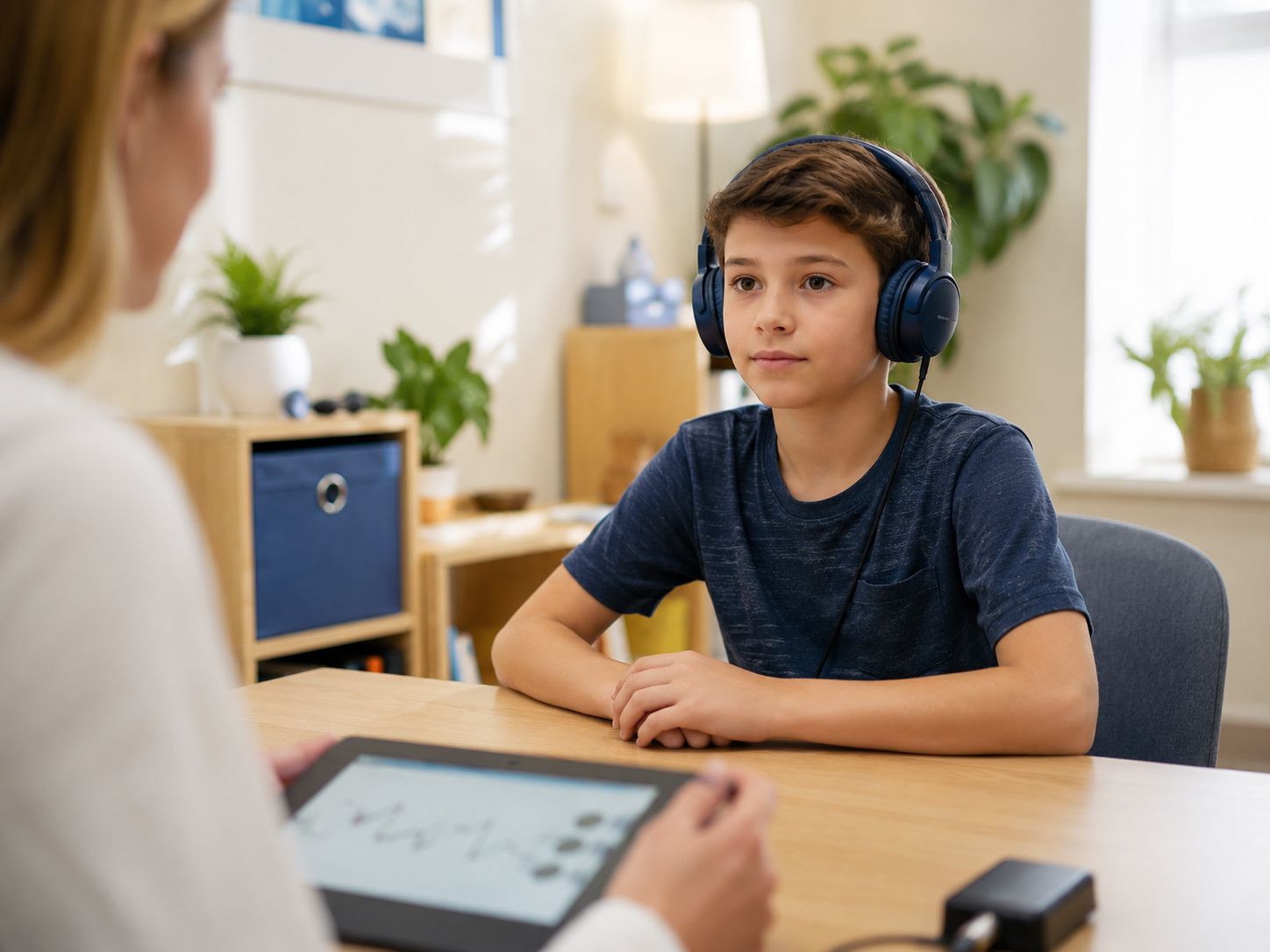
We start with an interview and observation of how a child understands and produces utterances and how they communicate. We use standardised tools, such as KORP for assessing overall development, and, when aphasia or delayed speech is suspected, an assessment of the child's language. We always discuss the result with the parent and translate it into a concrete plan.
How to support speech at home?
- Talk to your child a lot, simply and with engagement, describe everyday activities.
- Read picture books and name what you see in the pictures.
- Give time to respond and do not do things for the child when they try to say something.
- Limit screens, especially for the youngest, because passive watching does not teach communication.
- Respond to attempts to communicate, including with gestures, so the child feels it is worth communicating.
Speech is more than words
Looking at speech development, it is easy to focus on the number of words. Yet speech is a complex system that includes understanding, production, vocabulary, grammar, pronunciation, and also non-verbal communication, that is, eye contact, gestures and shared attention. A child who says little but understands a lot and readily communicates with gestures is in a different situation from a child who does not respond to speech and does not seek contact. That is why a specialist looks at the whole, not a single indicator.
What affects speech development?
The pace of speech development depends on many factors, worth knowing so as not to jump to conclusions, but also not to dismiss signals.
- Hearing. Even intermittent hearing loss, for example with recurring fluid in the ears, can delay speech. That is why, when in doubt, we check hearing.
- The speech apparatus. Muscle tone, the way of breathing, chewing and swallowing affect pronunciation.
- Language stimulation. The amount and quality of speech directed at a child, conversation, reading, shared play.
- Screen time. In the youngest, passive watching does not replace conversation and is sometimes linked with delays.
- Neurodevelopmental factors. Some delays have a basis in the workings of the nervous system and require specialist support.
Delayed speech and other difficulties
Delayed speech does not always mean a standalone problem. It can be one element of a broader picture, for example the autism spectrum, when alongside speech we observe difficulties in contact and communication, or auditory processing disorder. The task of assessment is to answer the question of whether it is an isolated speech delay or a signal of something more. This distinction decides the direction of support.
A young brain has the greatest plasticity, that is, capacity for change, in the early years of life. Support introduced early is usually shorter and more effective than therapy started only at school age, when difficulties have had time to become entrenched.
What does the first visit look like?
The first meeting is above all a conversation and observation, in a safe, calm atmosphere. We ask about the course of the pregnancy, the birth and development, about how the child communicates, what they understand, how they play. We observe the child in a natural situation, because it is precisely in play that their competences show best. The parent is our most important source of knowledge here, no one knows the child better. After the assessment we jointly decide whether support at home and observation are enough, or whether therapy is advisable.
Parents' most common questions
My son understands everything but does not talk. Is that a problem?
Good understanding is a favourable sign, but a persistent large gap between understanding and talking deserves a consultation, especially after the age of two.
Does bilingualism delay speech?
Being raised in two languages does not cause speech disorders. A child may temporarily mix languages, which is normal. However, if worrying signals appear, they are assessed independently of bilingualism.
Do boys talk later than girls?
There can be small differences, but they should not lull your vigilance. A clear delay in a boy is worth checking just as much as in a girl.
Do you have doubts about your child's speech?
Book a neurospeech consultation. We will calmly assess development and advise whether support is needed.
This article is for information only and does not replace a consultation or assessment. Milestones are approximate. For an individual assessment, see our speech & language therapist page.