

When a parent hears that we will use the Conners 3 test in an ADHD assessment, the question often follows, will this one test decide everything. The answer is no, and that is good news. Conners 3 is an important, but not the only, element of a reliable assessment. Here is how it works and how to understand its result.
What is Conners 3?
Conners 3 is a standardised questionnaire used to assess ADHD symptoms and related difficulties in children and teenagers, usually aged 6 to 18. It consists of questions about attention, hyperactivity, impulsivity, and functioning in learning, relationships and emotion regulation. Its strength is standardisation, that is, comparing the answers with norms for a given age and sex.
At BELMED® the Conners 3 test is carried out by Magdalena Dymarkowska, certified by the PTP Psychological Test Laboratory to use this category B2 instrument.
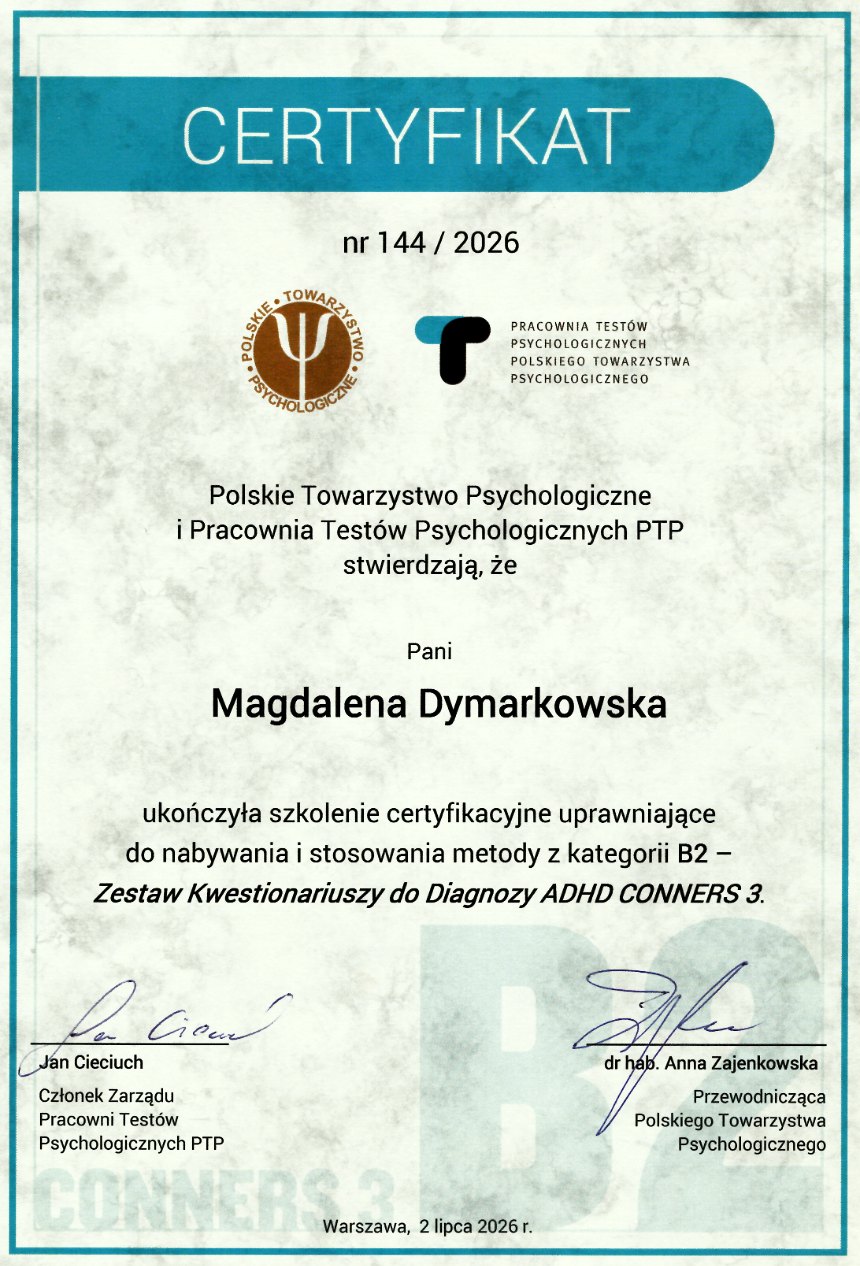 Conners 3 certificate (PTP, cat. B2)
Who fills it in, and why several people?
One of the most important features of Conners 3 is that it gathers perspectives from different settings. The questionnaire is usually completed by:
- A parent or carer, who knows the child at home and in everyday situations,
- A teacher, who sees the child in a group and in situations that require attention and self-control,
- The child, in the version for older children and teenagers, which reveals their own perspective.
This range of sources is crucial, because ADHD is only diagnosed when symptoms are present in more than one setting. A child who has difficulties in just one situation may need a different kind of support.
ADHD symptoms often show most clearly where sustained focus and self-control are needed, that is, at school. That is why a teacher's view can be invaluable and genuinely affects the reliability of the assessment.
The scales and areas Conners 3 examines
Conners 3 is not a single question about attention, but a broad set of scales. Alongside the core dimensions of ADHD it assesses areas that often accompany it and affect a child's functioning. These include, among others:
- Inattention, that is, difficulty sustaining focus and finishing tasks,
- Hyperactivity and impulsivity, that is, restlessness and acting without thinking,
- Executive function, that is, planning, organising and starting tasks,
- Learning difficulties, especially in reading, writing and arithmetic,
- Peer relationships and family relationships,
- Difficulties with emotion regulation, including irritability and outbursts.
This breadth means Conners 3 shows not only whether ADHD symptoms are present, but also how widely they affect a child's daily life.
What does the result mean?
The Conners 3 result is usually presented as scores showing how the intensity of a given area compares with the age norm. A high score on the attention or hyperactivity scale is a signal to look more closely at those areas, but it is not an automatic diagnosis. It is a clue that the specialist sets alongside other information.
Just as importantly, the result is always read by a specialist. The same numbers can mean different things in different contexts, so interpretation requires clinical knowledge, not just a glance at a table. It also happens that a parent's and a teacher's ratings differ. That is not an error, but valuable information that the child functions differently at home and at school.
Why isn't the test enough on its own?
A reliable ADHD assessment never rests on a single tool. Similar symptoms, such as difficulty concentrating, can stem from anxiety, sleep problems, auditory processing disorder or a difficult life situation. That is why we combine Conners 3 with an interview, observation and an assessment of functioning, and at BELMED® we also add EEG Biofeedback, which images how the brain works. We describe the whole process on the ADHD assessment page.
The specialist's task is not only to confirm or rule out ADHD, but also to check whether something else lies behind the symptoms, or whether ADHD co-occurs with another difficulty. A single questionnaire cannot settle that.
How to fill in the questionnaire so it is reliable
- Answer honestly, describing the child as they really are, not as you would like them to be.
- Think of typical, everyday behaviour, not one exceptional day.
- Do not compare answers with the other people completing it, because differences in perspective are valuable.
- If a question raises doubt, note it, and ask the specialist during the discussion.
After the assessment
The Conners 3 result, set alongside the rest of the picture, helps answer not only the question of ADHD, but also which areas need support. It is a starting point for a support plan, from psychoeducation and school support, through skills training, to EEG Biofeedback. We write more about the condition itself in our articles on ADHD in children and ADHD in adults. At BELMED® in Tczew we assess and treat ADHD in children and adults.
Considering an ADHD assessment?
Book a consultation. We will explain how the assessment works and what role the Conners 3 test plays in it.
This article is for information only and does not replace a consultation or assessment. For an individual assessment, see our ADHD assessment page.