
Every second our brain receives thousands of stimuli, sounds, touch, movement, smells, images. Usually it organises them automatically, so we do not even notice. In some children this process works differently, and then ordinary situations, a label in a shirt or the hum of a shop, become a source of enormous discomfort. This is the area of sensory integration.
What is sensory integration?
Sensory integration, SI for short, is the process in which the brain receives information from the senses, organises it and gives it meaning, so the body can respond appropriately. Besides the familiar senses, a huge role is played here by the sense of balance, that is, the vestibular system, and by deep sensation, that is, proprioception, thanks to which we know where our body is. When integration proceeds correctly, the child moves, learns and regulates emotions smoothly.
How do SI difficulties show up?
The picture varies greatly, because a child can be hypersensitive to stimuli, under-sensitive, or seek them out excessively. Typical signals include:
Hypersensitivity
- defensive reactions to touch, dislike of labels, certain clothes, getting hands dirty,
- covering the ears at sounds, fear of noise,
- food selectivity linked to texture and smell,
- uncertainty and fear with movement, swinging, heights.
Under-sensitivity and stimulus-seeking
- constant movement, a need to touch everything, to have firm pressure,
- unawareness of pain or temperature,
- sweeping, imprecise movements.
Motor and emotional difficulties
- clumsiness, tripping, trouble with balance and coordination,
- reduced or heightened activity, difficulty calming down,
- trouble with concentration, easy distraction and emotional outbursts.
The symptoms of SI difficulties are sometimes confused with misbehaviour, inattention or ADHD. This is why a reliable assessment matters, one that checks whether the source of the difficulty is sensory processing. Sometimes the challenges co-occur, for example with ADHD or the autism spectrum.
Where do sensory difficulties come from?
The causes are not always clear-cut. Factors linked to the course of pregnancy and birth, the pace of maturation of the nervous system and the child's individual development all matter. The modern excess of stimuli, sounds and images also burdens a young nervous system. One thing is important, an SI disorder does not result from parenting mistakes.
Three senses that are easy to forget
When we talk about the senses, we usually think of sight, hearing, taste, smell and touch. In sensory integration, however, a key role is played by three systems that work in the background yet have an enormous impact on a child's everyday life:
- The vestibular system, that is, the sense of balance. It is responsible for the body's orientation in space, coordination and muscle tone. When it works incorrectly, the child either avoids movement and swinging, or constantly seeks it out.
- Proprioception, that is, deep sensation from the muscles and joints. Thanks to it we know where our body is without looking. Its weakness results in clumsiness, too strong or too weak pressure, a need for firm contact.
- The tactile system. This is the first sense to develop in a human. Tactile hypersensitivity produces defensive reactions, and under-sensitivity, a need for intense touch.
The theory of sensory integration was developed in the 1960s and 1970s by Anna Jean Ayres, an occupational therapist and neuropsychologist. Contemporary SI therapy develops her ideas. It is worth knowing that the scientific evidence on effectiveness is sometimes debated, which is why we treat therapy as an element of broader, individually chosen support.
What does a sensory integration assessment look like?
A reliable assessment is not based on a single observation. It usually includes:
- An interview with parents. We get to know the developmental history, the course of pregnancy and birth, and the child's everyday difficulties.
- Questionnaires and observation. We check reactions to stimuli and patterns of behaviour in various situations.
- Clinical trials. Tasks assessing balance, coordination, muscle tone and stimulus processing.
- Analysis and plan. We create the child's sensory profile and plan therapy on its basis.
What does sensory integration therapy look like?
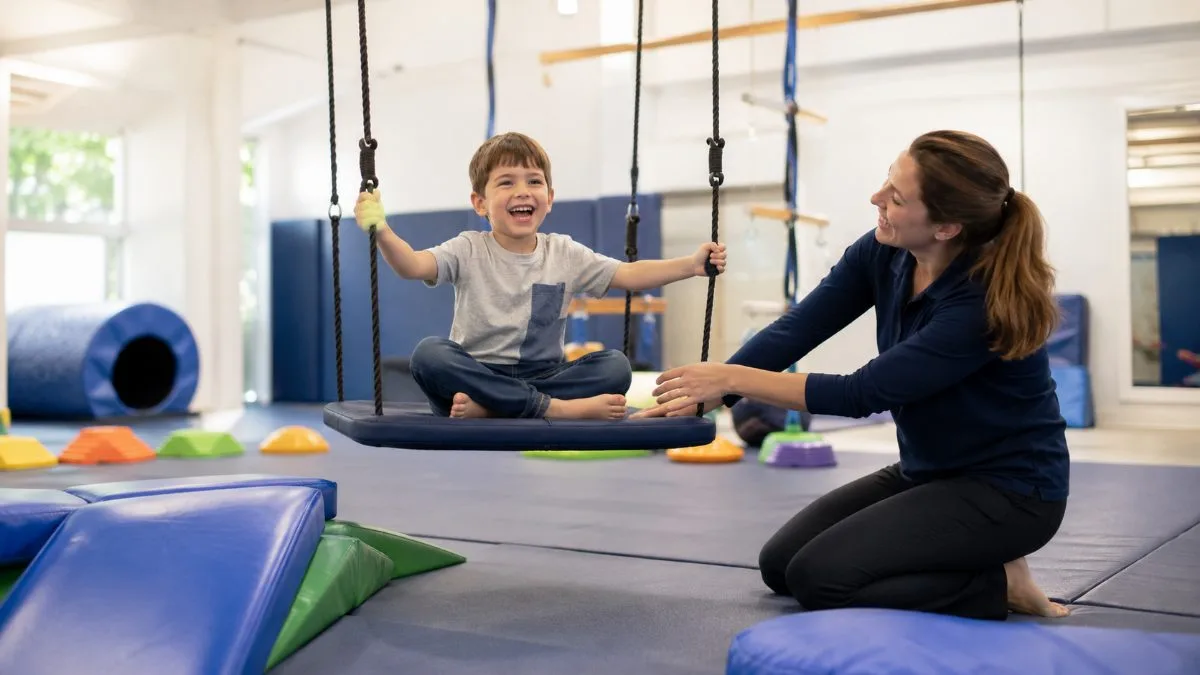
SI therapy takes the form of guided movement play that is attractive to the child, carried out on specialist equipment such as swings, platforms, balance boards and materials of different textures. The therapist selects stimuli so as to stimulate the senses in a controlled way and teach the brain to process them better. The child has the impression of playing, while at the same time doing precisely planned work.
Sensory integration, hand therapy and learning
Efficient sensory processing is the foundation of many skills, from concentration, through self-regulation, to precise movements of the hands. This is why sensory difficulties often go hand in hand with challenges in fine motor skills. In such situations we combine SI therapy with hand therapy, to support the child comprehensively rather than piecemeal.
SI, concentration and emotions
A child whose brain constantly struggles with an overload of stimuli has fewer resources for learning and regulating emotions. Hence the frequent distraction, outbursts of anger or withdrawal, which is easily read as a behaviour problem. Yet behind the behaviour lies an overloaded nervous system. Well-chosen sensory stimulation helps the child return to balance, focus more easily and react more calmly. This is why elements of the sensory approach can also help children with ADHD and on the autism spectrum.
The most common questions from parents
At what age should SI therapy start?
Therapy is most often run in children of pre-school and early-school age, when the plasticity of the nervous system is high. Indications are decided by a prior assessment.
Do children grow out of SI difficulties?
Some difficulties ease with age, but without support they can affect learning, self-esteem and relationships. Early help teaches the child strategies they use every day.
Is SI therapy the same as ordinary play?
No. Although the therapy looks like play, every exercise is precisely matched to the child's profile and run by a trained therapist, in safe, controlled conditions.
How to support your child at home?
- Observe which stimuli the child likes and which overwhelm them, and adjust the environment.
- Provide movement, outdoor play, climbing, swinging, rolling.
- Introduce predictable rituals that give a sense of security.
- Limit the excess of stimuli, especially before sleep and learning.
- Do not force contact with a stimulus that provokes strong fear, act gradually.
If your child's reactions to stimuli make everyday life, learning or relationships harder, it is worth consulting a specialist. At BELMED® in Tczew we support children with difficulties in sensory processing.
Are you worried about your child's reactions to stimuli?
Book a consultation. We will assess whether the difficulties stem from sensory processing and propose appropriate support.
This article is for information only and does not replace a consultation or assessment. For an individual evaluation, please contact our team of specialists.